
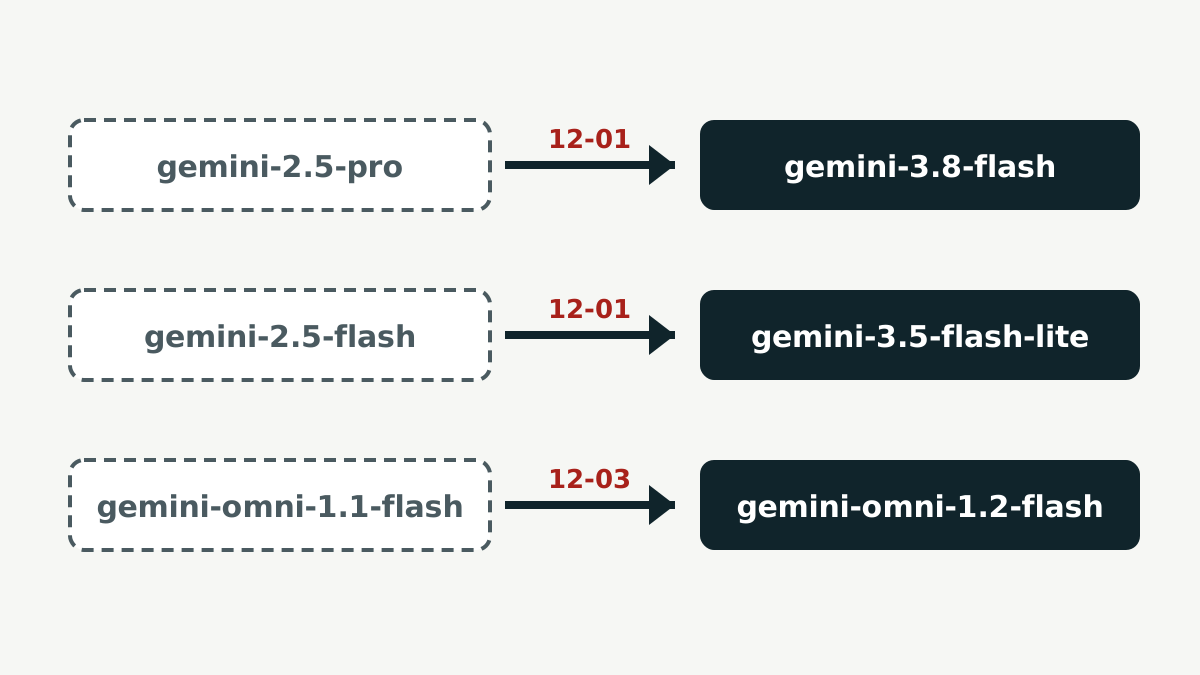
What you need to change before December 1
The most urgent item is the retirement of two models. Google's release notes of November 2 say Gemini 2.5 Pro and Gemini 2.5 Flash can no longer be selected in Google AI Studio. From December 1, 2026, the API will routesend a request made to one model name to a different model without the caller changing anything requests as follows:
gemini-2.5-progoes togemini-3.8-flash, billed at 3.8 Flash rates.gemini-2.5-flashgoes togemini-3.5-flash-lite, billed at 3.5 Flash-Lite rates.
Your application will keep answering, but with a different model. Google lists breaking changes that come with the switch: stricter validation of function calling and thought_signature, thinking_level replacing thinking_budget, and the removal of some sampling parameters and of prefilled model turns. Code that relies on any of those can fail or behave differently once the routing starts. Google's advice is to update the model string before then, which also lets you test the new model on your own prompts.
Gemini Omni 1.2 Flash is generally available
Generally availablethe stable release, supported for production use, as opposed to a preview that can change without notice means gemini-omni-1.2-flash is now meant for production. According to the release notes it generates video up to 15 seconds long and supports conversational editing, where you change a clip by describing the change. Video output costs $12.00 per million tokens, 30% less than before, and rate limits on the paid tier doubled.
The previous version, gemini-omni-1.1-flash, will be routed to 1.2 Flash from December 3, 2026, at 1.2 Flash prices.
Other changes in the same two weeks
- October 26: new paid-tier projects that use
generateContent,streamGenerateContentandbatchGenerateContentstore requests by default (store=true). Existing projects keep their current setting. You can opt out per request withstore=falseor in the Logs and Datasets settings. If your app sends personal or confidential data, check this setting. - October 27: a command-line client,
gemini-api, entered beta for coding agents, scripts and CI pipelines. - October 30: the Computer Usea tool that lets the model operate a computer interface, clicking and typing on screens, to complete a task tool became generally available.
- November 4: Gemini 3.8 Flash TTS can create stored custom voices from natural-language instructions.
- November 5: the API accepts PPT, ODP and ODS files as input, and tools can return audio, video and Office files to the model.
The release notes describe what changed, not how the models perform. For a model you can run on your own hardware instead, see our article on the Mistral Large 4 open weights, and for AI in security research, the Chrome 157 update credits 21 fixes to AI-assisted work.
Sources
Primary sources we checked for this article: